
OpenClaw vs Microsoft Scout: the control model is the real difference
The most important question in enterprise AI is changing.
For the last two years, business leaders have mostly asked:
Which model is best?
Which assistant should we buy?
Which copilot can summarize meetings, draft emails, write code or prepare reports?
Those questions still matter. But they are no longer enough.
The next question is sharper:
Who controls the agent when it starts acting?
That is why the comparison between OpenClaw and Microsoft Scout matters.
On the surface, it looks like a product comparison. OpenClaw on one side. Microsoft Scout on the other.
But that is not the real story.
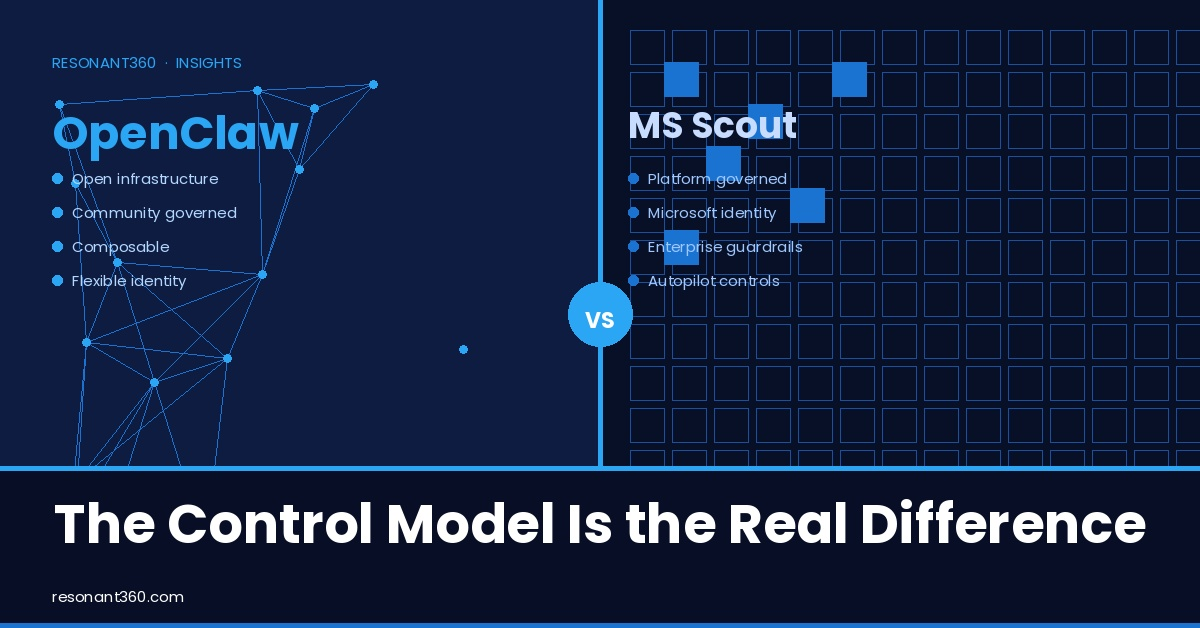
The real story is that OpenClaw and Microsoft Scout represent two different control models for the same emerging agent pattern.
OpenClaw points toward flexible, open, self-hosted, local-first agent infrastructure. It gives developers and businesses room to build their own agent workflows, connect to their own tools, choose their own models and run work on machines they control.
Microsoft Scout points toward governed enterprise packaging. Microsoft describes Scout as its first “Autopilot” agent: an always-on agent integrated across Microsoft 365, operating across cloud, desktop and web, connected to Teams, Outlook, OneDrive, SharePoint, browser, local resources and MCP servers, and powered by OpenClaw open-source technology.
That distinction is bigger than product branding.
It is the difference between agent capability and agent control.
OpenClaw asks:
What could an agent do if we had maximum flexibility?
Microsoft Scout asks:
What could an agent do if it lived inside Microsoft 365 identity, permission, approval and policy controls?
For business leaders, that is the useful comparison.
The future of agents will not be decided only by who has the most impressive demo.
It will be decided by who can let agents act without losing control.
From assistants to always-on agents
A normal assistant waits.
An always-on agent watches, remembers, checks, plans and acts.
That sounds useful because it is useful.
An agent can monitor your inbox, prepare for meetings, notice stalled decisions, draft follow-ups, search documents, update files, run code, check calendars, coordinate people and keep work moving in the background.
But the same shift also changes the risk.
A chatbot can give a bad answer.
An agent can take a bad action.
It can read the wrong file. It can send the wrong message. It can expose sensitive information. It can run the wrong command. It can update the wrong record. It can spend too much money in the background. It can act with more authority than the business intended.
That is why agents need to be treated as operational actors, not just smart interfaces.
Once AI can read, write, schedule, send, search, execute or trigger work, the architecture matters.
The business needs to know:
- Which identity is acting?
- Which permissions apply?
- Which systems can it touch?
- Which credentials does it use?
- Which actions require approval?
- Which data policies apply?
- What gets logged?
- How can the agent be stopped?
- What happens when the agent is wrong?
Those questions sit beneath the OpenClaw versus Scout comparison.
What OpenClaw represents
OpenClaw matters because it represents an open agent infrastructure pattern.
The official OpenClaw documentation describes it as a self-hosted gateway for AI agents across channels such as Discord, Google Chat, iMessage, Matrix, Microsoft Teams, Signal, Slack, Telegram, WhatsApp and others. A single Gateway process runs on your own machine or server and connects those channels to an always-available AI assistant.
In plain English, OpenClaw gives you a way to run an agent on infrastructure you control.
That is attractive for several reasons.
It is self-hosted.
It can be adapted.
It can connect across channels.
It is built for agent-native work: tool use, sessions, memory and routing.
It can support local or private deployment patterns.
It gives developers more room to shape the workflow rather than waiting for one vendor to expose exactly the feature they need.
That flexibility is the opportunity.
It is also the work.
Open infrastructure does not automatically give you enterprise governance. If you run an open agent with broad file access, local credentials, shell access, browser control and tool integrations, you have to design the controls around it.
That means identity, least privilege, approval gates, credential management, sandboxing, logging, monitoring, prompt-injection protection, tool allowlists, cost controls and incident response.
OpenClaw is powerful because it is flexible.
OpenClaw is demanding for the same reason.
What Microsoft Scout represents
Microsoft Scout is important because Microsoft is not simply announcing another assistant.
Microsoft is showing what happens when OpenClaw-style capability is wrapped in an enterprise control plane.
Microsoft’s announcement says Scout is integrated across Microsoft 365 apps, operates across cloud, desktop and web, connects to Teams, Outlook, OneDrive and SharePoint, and can be extended through the desktop app to browser, local resources and MCP servers.
Microsoft also says Scout is powered by OpenClaw open-source technology and that Microsoft is contributing policy conformance upstream to OpenClaw.
That is a significant signal.
It means Microsoft is not treating this agent pattern as a fringe experiment. It is taking the architecture seriously enough to make it part of the Microsoft 365 agent strategy.
But the key point is not simply that Scout uses OpenClaw technology.
The key point is how Microsoft wraps it.
Microsoft says Scout is built with enterprise-grade security and controls. It operates with its own governed Entra identity. Its credentials are scoped and protected. It can only reach approved resources and destinations. Sensitive actions can require human approval. Microsoft says Purview policies, including sensitivity labels and data loss prevention, are enforced before information is sent or written.
That changes the conversation.
The same broad class of agent capability becomes much more deployable when it sits inside existing identity, policy, compliance and administration systems.
That does not make it risk-free.
Microsoft’s own documentation describes Scout as a preview feature, subject to change. It says Scout can read, write and search files, run shell commands, control a browser, query Microsoft 365 data, operate in heartbeat mode, run automations and delegate work to sub-agents. It also says sensitive actions require explicit approval, background modes use more restrictive permission policies and administrators can manage access through Intune.
The enterprise promise is clear.
But so is the caution.
Scout is powerful. Scout is still AI. Scout still needs review, permission design, endpoint controls, deployment policy and careful use case selection.
Governed does not mean harmless.
Governed means manageable.
The same agent pattern, different control plane
This is the heart of the comparison.
OpenClaw and Microsoft Scout are not best understood as “open source versus Microsoft” in a simple ideological fight.
They are better understood as two control models.
OpenClaw gives you more architectural freedom.
Microsoft Scout gives you more built-in enterprise governance.
OpenClaw gives you more room to build custom workflows, connect specialist systems, route models, keep work local and design company-specific operating layers.
Microsoft Scout gives Microsoft-centric organisations a more familiar path: Microsoft 365 context, Entra identity, Microsoft permissions, Purview policy, Intune administration and a productivity surface that already sits inside daily work.
One is not automatically better than the other.
They answer different questions.
If the work lives in Teams, Outlook, OneDrive, SharePoint, calendar and Microsoft 365 collaboration, Scout-style architecture may be the natural control model.
If the work involves custom local processing, private files, specialist workflows, non-Microsoft systems, model routing, hardware control or a company-brain layer that spans unusual sources, OpenClaw-style architecture may be the better foundation.
If the work touches customer records, revenue operations, service processes, CRM workflows or enterprise records of truth, Salesforce Agentforce may be the right governed action layer.
The mistake is assuming every workflow should go into one platform.
The smarter question is:
Which system is best placed to govern this work?
Identity is the first difference
Agents need identity.
That may sound obvious, but it is one of the most important enterprise shifts.
If an agent sends an email, updates a record, edits a document, runs a script or retrieves sensitive information, the business needs to know who or what performed the action.
Was it the human user?
Was it a service account?
Was it an agent acting under delegated authority?
Was it a local process running with unclear permissions?
Without identity, auditability falls apart.
OpenClaw-style deployments can be designed with strong identity controls, but those controls are not automatic. A business has to decide how the agent authenticates, which accounts it uses, where credentials are stored, how permissions are scoped and how actions are logged.
Microsoft Scout starts from a different position. Microsoft says every Scout agent operates under its own governed Entra identity, so the work it does is attributable to a known actor in the directory.
That matters because identity is the anchor for every other control.
Permissions, logging, approvals, credential protection and incident response all depend on knowing what is acting.
An enterprise agent should not be an invisible extension of someone’s laptop.
It should be a governed participant in the operating environment.
Permissions are the second difference
The second difference is permissions.
An open local agent can be given enormous power very quickly.
It may be able to read files, run commands, operate a browser, call APIs, inspect repositories, connect to messaging platforms or write to external systems.
That is why OpenClaw-style systems need careful permission design. The default mindset should be:
Read-only first.
Limited scope first.
Human approval before write actions.
Explicit allowlists for tools and commands.
No broad credentials sitting casually on a workstation.
Microsoft Scout’s model is more centrally bounded. Microsoft says Scout depends on the user’s existing Microsoft 365 permissions and cannot access data or services that the account is not authorised to use. The documentation also describes tool categories, shell permission tiers, sensitive path controls, heartbeat-specific permission settings and action approval prompts.
That is exactly the kind of control plane always-on agents need.
But even here, business leaders should not get lazy.
If a user already has excessive access, an agent working through that user’s permissions may inherit too much reach.
AI governance does not fix bad access governance.
It exposes it.
Local execution is not a free pass
Local-first architecture is one of the strongest arguments for OpenClaw-style systems.
There are good reasons to run agent workflows locally or privately:
- Sensitive files may not belong in a hosted system.
- Latency may matter.
- Cost may be lower for routine work.
- Local hardware may be available.
- Specialist tools may only run inside the business environment.
- Some workflows may need private context, offline capability or tighter operational control.
But local does not automatically mean safe.
A local agent can still leak data.
It can still act on malicious instructions.
It can still use credentials badly.
It can still run commands the business did not intend.
It can still expose information through a browser, API, plugin, document or message.
This is why “local” should be treated as a deployment choice, not a governance strategy.
Local agents still need sandboxing, least privilege, secret management, audit logs, approval gates, endpoint protection, network controls and monitoring.
Microsoft Scout makes this point in a different way.
Its documentation says Scout can access local files within a configured workspace and that automation instructions and MCP output are stored locally on the end user’s device, not covered by the Microsoft 365 DPA and subject to endpoint management and device controls.
That is an important caveat.
Even a Microsoft-governed agent still has local endpoint implications.
The cloud control plane matters, but the laptop still matters.
Approval is where trust becomes practical
Agents should not be judged only by what they can do.
They should be judged by what they are allowed to do without asking.
That is especially important for always-on work.
An agent that drafts a message is useful.
An agent that sends it to a customer without review is a different risk category.
An agent that finds a contract is useful.
An agent that shares it externally is a different risk category.
An agent that checks a build is useful.
An agent that deploys code or runs a destructive command is a different risk category.
Microsoft Scout’s documentation is useful here because it separates interactive work from heartbeat and automation modes. Background modes are more restrictive because the user is not present to approve each action. Sensitive actions require approval, and some actions can be denied or blocked by policy.
That is the right pattern.
OpenClaw-style systems can implement similar approval gates, but a business has to design them.
That is not a weakness if the business has the capability.
It is a responsibility.
The goal should not be maximum autonomy.
The goal should be useful autonomy inside clear boundaries.
Model routing will become a business issue
Always-on agents change AI economics.
A chat assistant usually costs money when someone uses it.
An always-on agent may check context, watch for updates, run scheduled prompts, call tools, retry steps, search files, inspect messages, summarize changes and coordinate work in the background.
That can create real value.
It can also create cost drift.
If every background loop goes to an expensive frontier model, the business may lose control over operating cost.
That is why model routing matters.
Routine, low-risk work may not need the most expensive model available. Classification, file sorting, basic extraction, first-pass summarisation, lightweight drafting, status checking and simple internal coordination may be suitable for smaller, private, local or lower-cost models.
High-value reasoning, sensitive customer communication, complex synthesis, strategic judgement and work with high downside risk may justify a stronger model.
OpenClaw-style architecture may be attractive because it can give teams more direct control over model choice and deployment patterns.
Microsoft Scout’s path appears more managed. That may reduce operational burden, but it may also reduce model-routing flexibility depending on the final product model, licensing and enterprise configuration.
This should not be guessed.
It should be tested.
Before scaling always-on agents, business leaders should ask:
- How often will the agent run?
- How much context will it load?
- How many tools will it call?
- What model handles routine work?
- What model handles escalations?
- What does the workflow cost at real volume?
- What happens when the agent loops?
- Who monitors spend?
Model choice is no longer just an AI team decision.
It is an operating model decision.
Where Salesforce fits
The OpenClaw versus Scout comparison should not distract from Salesforce.
For many businesses, Salesforce is where the highest-value operational work lives.
Customer records.
Sales pipelines.
Service cases.
Revenue processes.
Account history.
Approvals.
Workflow.
Field-level security.
Role hierarchies.
Auditability.
Data Cloud and connected customer context.
That is why Agentforce has a different role from Scout or OpenClaw.
Microsoft Scout is naturally strongest where work lives in Microsoft 365: email, meetings, documents, collaboration and personal productivity.
OpenClaw-style custom architecture is naturally strongest where the business needs local execution, custom workflow specificity, model routing, private context or cross-system orchestration outside a single SaaS platform.
Salesforce Agentforce is strongest where agents need to operate around customer data, CRM workflows, service processes, revenue operations and trusted enterprise records.
The mature enterprise future is not one agent platform for everything.
It is a hybrid agent architecture.
Microsoft for productivity work.
Salesforce for customer and operational action.
Custom/OpenClaw-style systems for specialist internal workflows, company-brain layers, local/private AI and cross-system execution.
The challenge is not choosing the one true platform.
The challenge is deciding which platform should govern which work.
The risk is unmanaged authority
OpenClaw is not risky because it is open source.
Microsoft Scout is not safe merely because it is Microsoft.
Salesforce Agentforce is not automatically appropriate for every AI workflow because Salesforce is trusted.
The real risk is unmanaged authority.
That risk appears whenever an agent can act across systems without clear boundaries.
It appears when an agent has broad permissions.
It appears when credentials are stored badly.
It appears when local files are accessible without approval.
It appears when custom skills are not reviewed.
It appears when external content is treated as instruction.
It appears when logs are missing.
It appears when background automations keep running after the business has forgotten they exist.
It appears when teams chase agent capability before designing the control model.
That is the lesson business leaders should take from OpenClaw and Microsoft Scout.
The architecture of agency matters.
The control model matters more.
A practical decision framework
Before choosing between OpenClaw, Scout, Agentforce or a custom AI-native system, leaders should start with the workflow.
Not the platform.
The workflow.
Ask:
- What business problem are we solving?
- Which systems does the agent need to read?
- Which systems does it need to write to?
- What data sensitivity is involved?
- What actions could create customer, financial, legal, HR, security or operational risk?
- Which identity will the agent use?
- Which permissions should it have?
- Where are credentials stored?
- Which actions require human approval?
- What gets logged?
- Who reviews the logs?
- How is the agent paused, disabled or rolled back?
- What is the real cost at workflow volume?
- What proof would justify scaling?
Then choose the control model.
Choose Microsoft Scout-style architecture when the work lives mainly in Microsoft 365 and the business wants to use existing Microsoft identity, endpoint, productivity and compliance controls.
Choose Salesforce Agentforce when the work is centred on CRM records, customer operations, revenue processes, service workflows and governed business action inside Salesforce.
Choose OpenClaw-style custom architecture when the workflow needs local/private execution, model flexibility, custom tooling, specialist data sources, cross-system orchestration or a company-specific agent layer that cannot be cleanly built inside one platform.
Choose a hybrid model when the workflow crosses all three worlds.
Do not proceed yet when the business cannot define the data, permissions, approvals, owner, logs or success criteria.
That last category matters.
Some agent projects should wait.
Not because AI is not useful.
Because useful AI without governance becomes operational debt.
Proof before proposal
The wrong way to buy agents is to start with a platform commitment.
The better way is to start with proof.
Pick one workflow.
Map the data.
Classify the risk.
Define the allowed actions.
Set approval gates.
Choose the control model.
Test with realistic volume.
Measure time saved, quality improved, cost incurred and risk introduced.
Then decide what to scale.
This is especially important because the Scout and OpenClaw markets are moving quickly. Scout is currently preview-stage. OpenClaw is evolving rapidly. MCP patterns are still maturing. Model pricing, licensing, routing options and enterprise controls will keep changing.
The worst strategy is to freeze a whole architecture around a product announcement.
The better strategy is to build an operating model that can adapt.
The Resonant 360 view
At Resonant 360, our view is that the next stage of AI maturity is not about giving every team an agent and hoping the work improves.
It is about designing a governed AI operating layer.
That means understanding where Salesforce should be the trusted action layer.
It means understanding where Microsoft 365 should govern productivity agents.
It means understanding where custom AI-native systems, OpenClaw-style architecture and local/private AI can create value.
It means designing identity, permission, approval, logging, policy and model-routing decisions before agents are allowed to operate across real business systems.
It also means being honest about maturity.
OpenClaw-style architecture is powerful, but it needs enterprise hardening.
Microsoft Scout is promising, but it is still preview-stage and still depends on correct configuration, endpoint controls, user permissions and human review.
Salesforce Agentforce is strong where CRM trust and business process governance matter, but not every AI workflow belongs inside Salesforce.
The winning architecture will be hybrid.
But hybrid does not mean messy.
It means each agent workflow is matched to the system that can govern it properly.
The point is not to choose between openness and control.
The point is to combine them intelligently.
Open infrastructure gives businesses flexibility.
Enterprise control planes make agents deployable.
Proof tells you whether the workflow is worth scaling.
That is the real OpenClaw versus Microsoft Scout lesson.
The agent future will not be won by the organisation with the most autonomous software.
It will be won by the organisation that knows exactly what its agents are allowed to do.
Need AI assistance?
Our team of experts are ready to help you with all your AI needs. Send us a message by filling out the form below.