
Microsoft Scout vs NVIDIA NemoClaw: two enterprise paths for always-on agents
The agent market is starting to split. Not between chatbots and better chatbots. Not between one model and another model. Not even between Microsoft, NVIDIA, Salesforce, Google, OpenAI or Anthropic as individual vendors.
The real split is architectural. Where does the agent run? What systems can it touch? Whose identity does it act under? Which permissions constrain it? Where does the model execute? What happens when the agent needs to use a file, call an API, run code or continue working in the background?
Those questions are becoming more important than the interface.
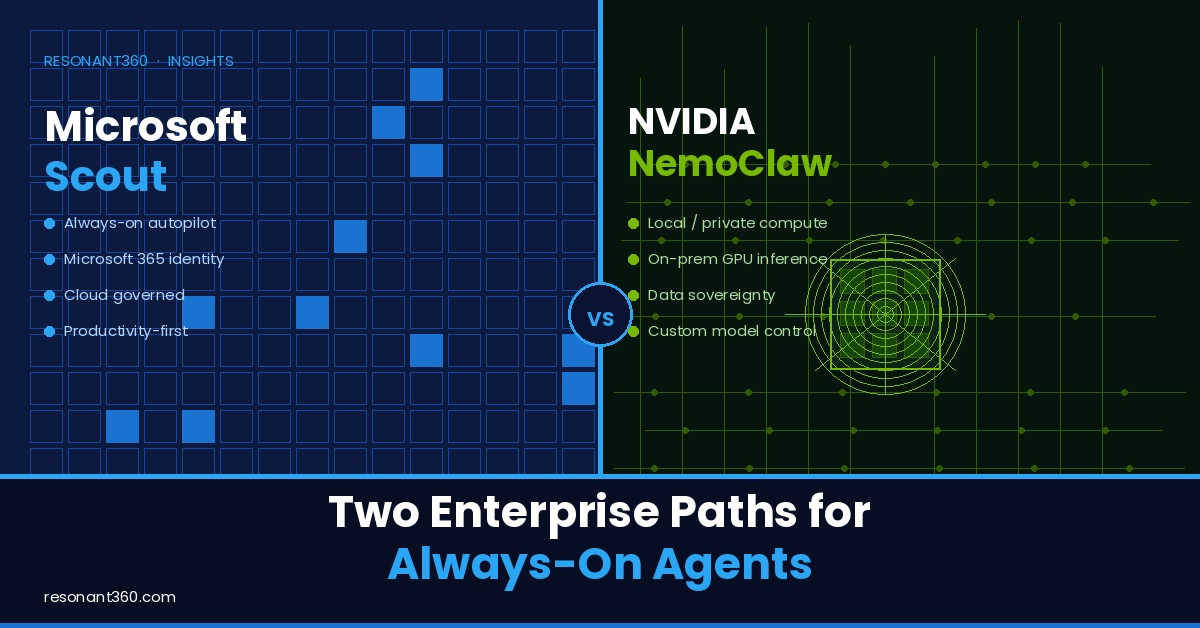
Microsoft Scout and NVIDIA NemoClaw are useful because they show two different answers to the same enterprise problem. Microsoft Scout points toward the productivity-suite path: always-on agents grounded in Microsoft 365, governed through Microsoft identity, access controls, data protection and admin policy. NVIDIA NemoClaw points toward the local/private compute path: OpenClaw-style agents running inside safer local environments, with OpenShell sandboxing, inference controls, hardware acceleration and private deployment options.
These are not direct substitutes. They are different control models. And that is the point business leaders need to understand.
The enterprise agent question is no longer, “Which assistant can do the most impressive demo?” The better question is: which agent architecture fits this workflow?
From copilots to autopilots
Most business AI still waits for a prompt. A person asks. The AI answers. That pattern is useful, but it is limited.
The next wave is more continuous. Agents will not only respond to a request. They will monitor context, prepare work, notice exceptions, coordinate tasks, retrieve information, use tools and carry work forward while a person is focused somewhere else.
Microsoft calls this new category “Autopilots.” In its announcement for Microsoft Scout, Microsoft describes Autopilots as always-on agents that work autonomously, operate with their own identity and take action on a user’s behalf within the permissions and policies the organisation sets.
That is an important shift. It means the agent is no longer just a text generator. It becomes an actor inside the business.
Once an agent becomes an actor, the governance model changes. You need to know what authority it carries, which files it can read, which messages it can inspect, which systems it can connect to, which actions require approval, which actions are logged and which policies stop it from doing the wrong thing.
This is why Scout matters. Microsoft is not simply adding another chat surface to Microsoft 365. It is showing how always-on agents may be embedded into the productivity layer where work already happens: Teams, Outlook, OneDrive, SharePoint, calendar, contacts, local resources, browser activity and MCP servers.
That does not make Scout the answer to every agent problem. It makes Scout a clear example of one enterprise path: the productivity-governed path.
The Microsoft path: productivity and governance
Microsoft Scout is designed for the work that already lives inside Microsoft 365: meeting preparation, scheduling, email and calendar coordination, document context, file organisation, surfacing stalled decisions and keeping routine work moving without requiring a person to prompt every step.
The strategic advantage is obvious. Microsoft owns a large part of the modern work surface. If an always-on agent can operate across Teams, Outlook, OneDrive and SharePoint, it can sit close to the daily coordination work that consumes a huge amount of organisational time.
But the more important detail is governance. Microsoft says Scout is powered by OpenClaw open-source technology, but wrapped in Microsoft 365 enterprise controls. The agent operates with its own governed Entra identity, not as an anonymous service account. Microsoft also describes credential protection, approved resource access, human sign-off for sensitive actions and enforcement of Microsoft Purview data protection policies such as sensitivity labels and loss prevention.
That is the pattern enterprises should care about. An always-on agent should not be a vague extension of a user’s session. It should have an identity. It should have boundaries. It should operate within existing policies. It should be auditable. It should be stoppable.
The Scout path is strongest where the work lives inside the Microsoft environment and the organisation already uses Microsoft as a governance backbone. For a Microsoft-heavy business, that may be extremely compelling.
But there is a boundary. Microsoft 365 is not the whole business. Scout may be useful for productivity workflows, but it is not automatically the right place to govern customer records, revenue operations, field service processes, ERP transactions, specialist operational systems or highly customised internal workflows.
The NVIDIA path: local compute and sandboxed execution
NVIDIA NemoClaw points to a different part of the agent market. NVIDIA describes NemoClaw as an open-source reference stack for running always-on AI agents more safely inside NVIDIA OpenShell sandboxes. It provides onboarding, lifecycle management and agent operations inside OpenShell containers, with additional security and inference routing capabilities.
In plain English, NemoClaw is less about putting an agent inside a productivity suite. It is more about making local or private agent execution practical.
That matters because not every workflow should run through a cloud productivity assistant. Some work is too sensitive, too local, too compute-heavy or too dependent on private files, scripts, development environments or data that the business does not want flowing through a general cloud interface. Some teams need to run agents near the data, near the hardware or inside a controlled environment.
NVIDIA is pairing OpenClaw-style agents with OpenShell runtime controls, local or routed inference, sandbox boundaries, policy enforcement and NVIDIA hardware. Its materials talk about running autonomous agents with policy controls, lifecycle management and sandboxing, while allowing model choices that may include local open models, cloud frontier models or model routing under privacy and security controls.
This is a different enterprise bet. Microsoft is saying: put the agent close to the work graph and govern it through Microsoft 365. NVIDIA is saying: put the agent close to compute, local models and controlled execution environments. Both paths make sense. They solve different problems.
Why runtime location matters
Runtime location sounds technical. It is actually a business issue. Where the agent runs affects privacy, latency, cost, resilience, compliance, data access, IT management and risk.
If an agent runs inside a cloud productivity environment, it can easily connect to meetings, email, files and collaboration systems. It can benefit from centralised identity, policy and admin controls. It may be easier for IT to deploy across an organisation that already lives in that suite.
But cloud productivity agents may not be the right fit for sensitive local files, heavy private inference, regulated processing, internal development workflows, air-gapped environments or workflows that span systems outside the productivity suite.
If an agent runs locally or in private infrastructure, the business gets different trade-offs. It may gain stronger control over data location, reduce the need to send raw files to external services, route routine work to local models, run closer to specialist hardware and support private experimentation before connecting live systems.
But local or private execution is not automatically safer. It shifts the control burden. Someone must manage the sandbox, the model, the hardware, the logs, the updates, the policies, the credentials and the endpoint risk. Local agents can still leak data, be over-permissioned or run destructive commands if the sandbox is weak.
Local does not mean governed. It only means the control plane is closer to you. That is valuable, but only if you actually build the control plane.
The same OpenClaw pattern, two commercial wrappers
The common thread is OpenClaw-style agent infrastructure. OpenClaw matters because it points toward a more open agent foundation: agents that can operate in the background, connect to tools, maintain context, use local resources and work beyond a single chat window.
But raw agent infrastructure is not enough for business adoption. Enterprises do not want to run powerful background agents as unmanaged experiments across desktops, files, systems and APIs. They need wrappers. They need identity, permissions, audit logs, approvals, sandboxing, monitoring, support and a way to prove value before scale.
That is where Microsoft and NVIDIA are interesting. Microsoft wraps OpenClaw-style capability in Microsoft 365 identity, productivity context and policy controls. NVIDIA wraps OpenClaw-style capability in local/private compute, OpenShell sandboxing and inference infrastructure.
The open foundation matters. The wrapper matters more. Linux did not become enterprise infrastructure because every company wanted raw open-source code. It became enterprise infrastructure because vendors and partners made open foundations operationally safe enough to trust. The same may happen with agents.
Productivity governance vs local compute
Here is the simplest way to frame the difference. Scout is for the work graph. NemoClaw is for the compute graph. That is not a perfect technical description, but it is useful for business leaders.
Scout fits where the value comes from understanding and acting inside the flow of work: meetings, email, documents, calendar, collaboration, task coordination and Microsoft 365 context. NemoClaw fits where the value comes from controlled execution: local models, private data, sandboxed agents, hardware acceleration, developer workflows, technical automation and workloads that need stronger control over where inference and actions happen.
One is closer to the employee’s day. The other is closer to the enterprise’s compute boundary. One leans into Microsoft 365 governance. The other leans into local/private infrastructure governance. Both still need business process design. Neither removes the need for architecture.
The buyer mistake: treating them as competitors
The obvious mistake is to frame Scout and NemoClaw as a simple vendor contest. “Which one wins?” That is the wrong question.
The better question is: which workflow are we trying to govern?
If the workflow is about meeting preparation, file follow-up, scheduling, collaboration and Microsoft 365 coordination, Scout is the more natural direction. If the workflow is about private document processing, local model execution, sandboxed code, technical research, controlled data handling or hardware-backed inference, NemoClaw is the more natural direction.
If the workflow is about customer records, service cases, account history, revenue operations, workflow approvals or CRM data, Salesforce Agentforce may be the stronger governed foundation. If the workflow spans several systems and needs bespoke logic, the right answer may be custom AI-native architecture that connects multiple layers carefully.
Most enterprises will not have one agent platform. They will have agent domains: productivity agents, customer-operation agents, local/private agents, developer agents, document agents and workflow agents. The strategic work is not to pick one winner. The strategic work is to define which agent domain is allowed to do what.
Where Salesforce Agentforce fits
Scout and NemoClaw do not replace Salesforce Agentforce. They sit around a different centre of gravity.
Salesforce is strongest where the work depends on trusted customer data, revenue workflows, service processes, case history, account records, opportunities, approvals, metadata, permissions and platform auditability. Customer data is not just another document set. It is operational truth.
If an agent is recommending next-best actions for sales, handling a service case, updating customer records, drafting customer responses, triggering a workflow or coordinating account activity, the business needs the agent to respect the system of record.
Salesforce already has many of the control ingredients serious agents need: user permissions, role hierarchy, sharing rules, field-level security, metadata, Flow, Apex, audit and monitoring patterns, Data 360, Agentforce and Einstein Trust Layer protections and guardrails.
That does not mean every AI workflow belongs in Salesforce. It means customer and revenue workflows should not be casually governed by a desktop assistant or a local sandbox simply because those tools are powerful.
The right architecture may look like this: Scout helps a manager prepare for meetings, coordinate follow-ups and keep Microsoft 365 work moving. Agentforce handles the governed customer, sales and service actions inside Salesforce. NemoClaw supports private document processing, local inference, technical research or sandboxed automation where local/private execution matters. Custom AI-native layers connect knowledge, workflows, approvals and model routing across the business.
The governance problem is the same everywhere
Scout and NemoClaw solve different parts of the architecture, but they share the same underlying risk: agents can act. Once agents can act, governance becomes non-negotiable.
A productivity-suite agent can be exposed to risky instructions in an email, meeting note, shared file or Teams message. A local/private agent can be exposed to risky instructions in a local document, repository, browser page, script or dataset. A CRM agent can be exposed to messy data, ambiguous customer records, poor process design or over-broad permissions.
Different environments. Same basic issue. The agent may misread context, overstep authority, follow malicious instructions, leak sensitive data, call the wrong tool, update the wrong record or burn cost through repeated loops.
The minimum governance pattern is consistent: least-privilege access, clear identity, scoped credentials, tool allowlists, data classification, human approval for sensitive actions, audit logs, monitoring, sandboxing where agents can use local resources or run code, prompt-injection and tool-injection testing, incident response, cost controls and clear ownership.
The most dangerous phrase in enterprise AI is “it is just an assistant.” That may be true when it only answers a question. It is not true when it can read, write, connect, execute or continue in the background.
Local AI does not automatically mean secure AI
A lot of leaders hear “local AI” and assume it solves the security problem. It does not.
Local execution can reduce some risks. It may keep raw files closer to the organisation, reduce dependence on external model APIs for routine work, improve latency, support private deployments and make cost more predictable for certain workloads.
But a local agent can still be dangerous. If it can read the wrong directory, it can expose sensitive files. If it can run commands, it can damage the machine or network. If it has broad credentials, it can misuse them. If its network access is open, it can send data out. If logs are weak, the business may not know what happened.
This is why NemoClaw’s emphasis on OpenShell sandboxing is strategically important. The value is not “local agents are safe.” The value is “local agents need serious runtime controls.” That is the correct lesson.
Cloud governance does not automatically mean complete governance
The reverse is also true. Putting an agent inside a governed cloud platform does not solve every problem. Microsoft 365 identity, access controls, Purview policies and admin configuration are powerful, but they are only as good as the environment they govern.
If permissions are messy, the agent may inherit messy access. If sensitivity labels are inconsistent, data protection may be inconsistent. If approval flows are too broad or too narrow, users will either bypass them or drown in friction. If the business does not know which workflows Scout should own, an always-on agent may become another layer of unclear accountability.
Governance tools matter. Governance design matters more.
A practical decision framework
Before choosing Scout, NemoClaw, Agentforce or a custom AI architecture, leaders should ask a few plain questions.
First: where does the work live? If the work lives in Microsoft 365, Scout may be the natural starting point. If the work lives in Salesforce customer records, Agentforce may be the natural starting point. If the work lives in local files, code, sensitive documents, technical workflows or private compute environments, NemoClaw-style architecture may be worth testing. If the work spans all of them, assume hybrid from the beginning.
Second: what can the agent do? Reading is different from writing. Drafting is different from sending. Recommending is different from executing. Local file access is different from local command execution. Every step up the action ladder needs stronger controls.
Third: what data is involved? Public data, internal data, confidential data, customer data, regulated data, source code, financial data and HR data all carry different risk. The more sensitive the data, the more carefully the runtime, model path and approval model need to be designed.
Fourth: who owns the workflow? An agent without an owner becomes an operational liability. Someone must own the use case, the approval rules, the test cases, the exception path, the logs and the decision to scale.
Fifth: what proof do we need? Do not buy the architecture from the demo. Prove it in the workflow. Test the actual documents, permissions, latency, cost, approval path, failure modes and whether users trust the output enough to change how they work.
What a good proof should test
A serious agent proof-of-concept should not only test whether the agent can complete a task. It should test whether the business can control the task.
For a Scout-style proof, test whether the agent can operate usefully inside the Microsoft 365 workflow, respect identity, permissions and data protection controls, require human approval for the right actions, reduce coordination work without creating noise, expose what happened to IT and show real usage cost.
For a NemoClaw-style proof, test whether the agent can run inside a controlled sandbox, which local files and directories it can access, which network destinations are blocked or approved, which model handles which workload, whether local inference provides enough quality, whether logs can be exported into existing monitoring and whether the organisation has the skills to operate it.
For an Agentforce proof, test whether the agent can use trusted CRM context, respect Salesforce permissions and process rules, support sales, service or customer workflows without bypassing approval, earn user confidence and improve a measurable business outcome.
The point is to evaluate the whole operating model, not only the AI output.
What would prove each path is winning
Scout becomes more strategically important if Microsoft shows broad adoption across Microsoft 365 customers, strong admin controls, useful Work IQ experiences, credible auditability, reliable human approval patterns and practical deployment paths beyond early previews.
NemoClaw becomes more strategically important if developers and enterprises adopt OpenShell-based sandboxing, local agent deployment becomes easier, NVIDIA hardware becomes a practical agent runtime layer, local model quality keeps improving and enterprises can connect the logs, policies and lifecycle management into their existing IT stack.
Agentforce becomes more strategically important as Salesforce proves high-value customer, service, revenue and workflow agents that respect enterprise data governance and deliver measurable operating outcomes.
OpenClaw becomes more strategically important if it continues attracting vendor support, community contribution, policy conformance work, runtime integrations and commercial wrappers without fragmenting into incompatible agent stacks.
Those are the signals to watch. Not the demo videos. The operational evidence.
The Resonant 360 view
At Resonant 360, our view is that enterprise AI is becoming an operating architecture problem. That is good news. It means the conversation is maturing.
The question is no longer whether AI can draft a document, summarise a meeting or produce a clever response. It can. The question is whether the business can turn AI into controlled, useful, observable work.
Scout and NemoClaw show two important parts of that future. Scout shows the promise of always-on productivity agents governed through the Microsoft 365 environment. NemoClaw shows the promise of local/private agent infrastructure with stronger runtime controls and hardware-backed execution. Salesforce Agentforce shows the importance of governed agents around customer records, revenue workflows and enterprise systems of truth.
Custom AI-native systems will fill the space between them: company-brain layers, document-heavy workflows, local/private tools, model routing, cross-system orchestration and business-specific agent experiences.
The winning architecture will not be one agent platform everywhere. It will be the right agent in the right domain, with the right controls, connected to the right system of record, tested through the right proof.
That is the real enterprise agent strategy. Not more autonomy for its own sake. Controlled autonomy. Not more tool access everywhere. Scoped access where it creates value. Not one vendor worldview. A governed hybrid architecture that reflects how the business actually runs.
Microsoft Scout and NVIDIA NemoClaw matter because they make that split visible. One path brings agents into the governed productivity layer. The other brings agents into controlled local/private compute. Both will matter.
But neither removes the work leaders must do. Before businesses scale always-on agents, they need to answer the boring questions with discipline: what can the agent see? What can it do? Who approved it? Where does it run? What happens when it is wrong? Who owns the outcome?
Those questions are not blockers. They are how AI becomes real infrastructure.
Need AI assistance?
Our team of experts are ready to help you with all your AI needs. Send us a message by filling out the form below.