
LLM-agnostic agents are the real enterprise endgame
Enterprise AI has spent the last two years arguing about which large language model is best. That question still matters, but it is no longer the most important one for organisations trying to build durable AI capability. The more strategic question is simpler: can the business change models without rebuilding the way work gets done?
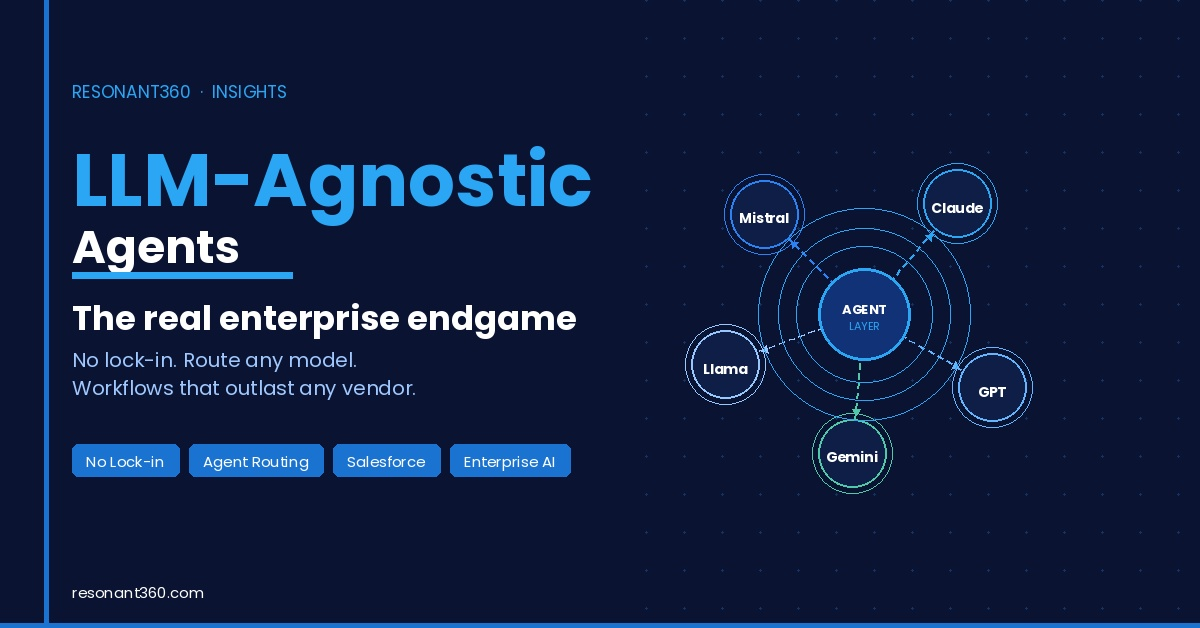
That is why LLM-agnostic agents are becoming the real enterprise endgame. They separate the agent workflow from the model underneath it, so the business can route tasks to the right model, apply consistent controls, and keep improving as the market changes.
The model race is not the architecture
Every new model release creates another round of benchmarks, demos and internal debate. One model is better at reasoning. Another is cheaper for high-volume summarisation. Another has stronger multimodal support or a context window that suits a particular use case. Those advantages are real, but they are also temporary.
Enterprises should not mistake today’s model preference for tomorrow’s architecture. The architecture needs to survive a market where capability, pricing, latency, privacy options and deployment patterns keep changing. If the agent is tightly coupled to one provider, every change becomes expensive. If the agent layer is designed to be model-agnostic, the organisation can adapt without rebuilding the whole system.
What LLM-agnostic really means
LLM-agnostic does not mean pretending all models are the same. It means building the surrounding agent system so that model choice is a configurable decision, not a hard-coded dependency.
- The workflow is defined independently from the model.
- The tools and systems the agent can access sit behind stable interfaces.
- The prompts, policies and guardrails are governed centrally.
- The organisation can route different tasks to different models.
- Performance, cost and risk can be measured across providers.
In practical terms, the model becomes one component in a broader operating model. The agent still needs a model to reason, draft, classify or decide next steps, but the business is not trapped if a better option appears.
Why model lock-in becomes operational risk
In traditional software, vendor lock-in is usually a commercial problem. In AI systems, model lock-in can become an operational risk because the model influences cost, quality, compliance, user experience and the pace of improvement.
A team may begin with a single model because it is fast to prototype. That is sensible for early learning. The risk appears when prototypes become embedded in processes and nobody has designed a way to swap, compare or route models later. At that point, the enterprise is not choosing a model. It is inheriting one.
This matters most when agents are connected to live customer, sales, service or operational workflows. Once the agent is part of real work, changes need to be tested, governed and rolled out with care. A model-agnostic design gives teams a cleaner way to manage that change.
Agents need a control plane, not just a model
The strongest enterprise agent strategies are built around a control plane. That control plane defines what the agent is allowed to do, which tools it can use, what data it can access, how it handles exceptions, how it records decisions and how performance is monitored.
Without that layer, the model ends up carrying too much responsibility. Teams start relying on prompt instructions to enforce rules that should be part of the system design. That can work for demos, but it is not enough for enterprise-grade deployment.
A control plane gives the organisation a place to manage policy, auditability and routing. It also creates a more practical path to model independence, because the same workflow can call different models without losing its operational structure.
Model routing will become normal
The future is unlikely to be one model for everything. Enterprises will increasingly route tasks based on the type of work being done. A simple classification task may use a fast, lower-cost model. A complex planning task may use a more capable reasoning model. A sensitive workflow may use a model with specific data handling or residency options.
This is similar to how businesses already make infrastructure decisions. Not every workload needs the same compute, database or integration pattern. AI will mature in the same direction. The question will shift from “which model are we using?” to “which model should this workflow use for this step, under these conditions?”
Governance has to travel with the workflow
Model flexibility only works if governance travels with the workflow. If each model has its own isolated prompts, controls and logging, the organisation creates fragmentation instead of resilience.
The goal is a consistent governance pattern across the agent estate. That includes permissioning, human approval points, monitoring, testing, escalation rules and records of what happened. When those controls live above the model layer, the organisation can experiment with new providers without starting again each time.
This is particularly important for teams working with CRM, service, marketing, finance or operational data. The agent may be changing the speed of work, but it still needs to respect the same business rules, data boundaries and trust expectations as the rest of the enterprise.
Where Salesforce, Microsoft and custom systems fit
Most enterprises will not choose between platform agents and custom agents in a simple either-or way. They will end up with a portfolio. Some use cases will sit naturally inside Salesforce, Microsoft or another business platform. Others will need custom orchestration across multiple systems, data sources and model providers.
LLM-agnostic thinking helps here too. It encourages teams to separate the business workflow from the underlying model and from any one application boundary. That makes it easier to decide where a platform-native agent is enough, where integration is needed, and where a custom agent layer will create better long-term control.
The buyer mistake: choosing a model before a workflow
A common mistake is to begin procurement by choosing a model or AI platform before the organisation has clarified the workflow. That puts the decision in the wrong order. The workflow should define the requirements: data access, user experience, risk tolerance, latency, approvals, audit needs, cost profile and expected business outcome.
Once those requirements are clear, model choice becomes much more rational. The team can ask which model is best for each part of the workflow, what fallback is needed, how the output will be evaluated, and how the architecture will adapt as better options become available.
A practical decision framework
For enterprises moving from experimentation to real deployment, a useful framework is to separate decisions into four layers.
- Workflow: what job should the agent perform, for whom, and with what approval points?
- Data and tools: which systems can the agent read from or act within, and under what permissions?
- Governance: how will quality, risk, audit, privacy and human oversight be managed?
- Model routing: which model is best suited to each step based on capability, cost, latency and risk?
This structure keeps the model decision important but contained. It also helps teams avoid over-committing to a provider before they understand the business process they are trying to improve.
What a good proof should test
A serious proof of concept should test more than whether an agent can produce a good answer once. It should test whether the agent can operate reliably when the workflow becomes messy.
- Can the agent handle missing or conflicting data?
- Can it explain why it chose a next step?
- Can it escalate to a human when confidence is low?
- Can the same workflow run against more than one model?
- Can the team compare cost, quality and latency across model options?
- Can governance and logging remain consistent if the model changes?
These tests reveal whether the organisation is building a durable agent capability or just a polished demo. The difference becomes obvious when the use case moves into production.
The Resonant 360 view
The enterprise endgame is not a single winning model. It is an agent architecture that lets the business keep choosing well as the model market changes.
That means designing around workflows, controls and data access first, then using models as interchangeable sources of capability. It also means building evaluation and governance into the operating model from the start, so new model options can be adopted with confidence rather than panic.
LLM-agnostic agents give enterprises room to move. They protect the organisation from premature lock-in, create a cleaner path for experimentation, and make AI investment more resilient. For leaders planning the next stage of enterprise AI, that flexibility is not a technical detail. It is the strategy.
Need AI assistance?
Our team of experts are ready to help you with all your AI needs. Send us a message by filling out the form below.